Best Juicers Guide
Roundup · Cold Press Juicers for Home Kitchens

The Best Cold Press Juicers

A cold press juicer crushes produce with a slow auger instead of shredding it on a spinning disc, and that single mechanical choice explains almost everything else about these machines: the low wattage, the long warranties some makers are willing to write, and the gap between a 5.4-inch chute you still chop fruit for and a self-feeding hopper that takes a whole recipe. We compared published specifications and current Amazon prices for six masticating juicers, from a $66 entry machine to a $479 self-feeding flagship, reading every listing for what it states rather than what it implies.

By Ilane TallUpdated November 29, 2026Research-based.

Affiliate disclosure: Best Juicers Guide is reader-supported. We may earn a commission on qualifying purchases made through the Amazon links below, at no extra cost to you — see our privacy policy for details.


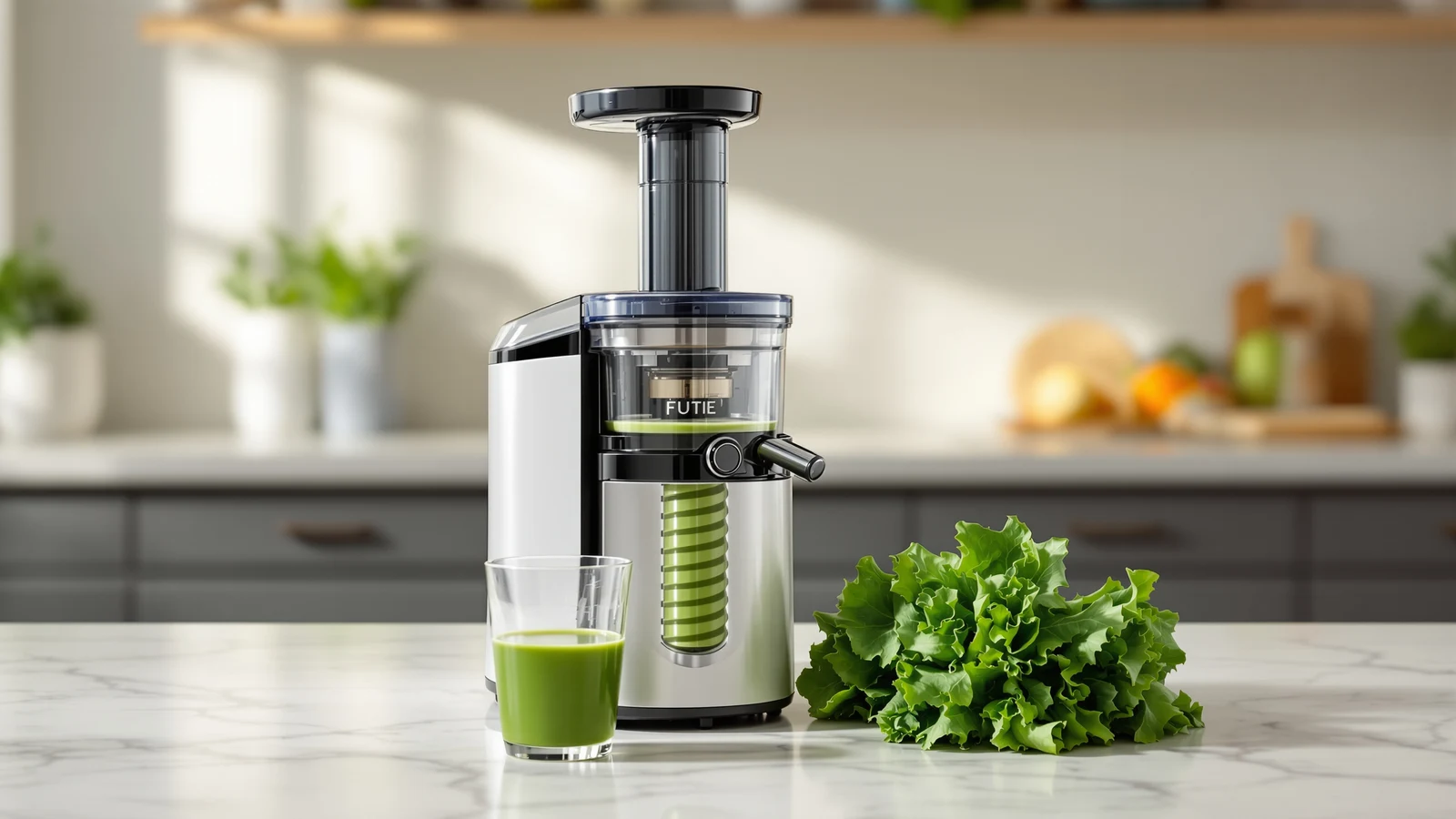
Slow cold press juicer crushing whole apples and leafy greens in a wide self-feeding hopper beside a glass of fresh green juice
Quick answer

If you want one answer: buy by chute width and warranty, not by watts.

Every cold press juicer here crushes produce the same basic way, so what actually differs is the feed chute, what the maker backs the motor with in writing, and the price. The Godspeeds Smoothpress is the one we’d point most people to first: a 6-inch chute, a 10-year warranty, and quick-release parts, at $93.48. The Nama J2’s self-feeding hopper takes a whole recipe at once with a 15-year warranty, at a premium price. The AMZCHEF, at $66.49, is the cheapest honest way in. Full comparison below.

The mechanism

What “cold press” actually means: auger, screen and RPM

Crush, don’t shred

A cold press, or masticating, juicer pulls produce into a chamber where a screw-shaped auger turns slowly, squeezing it against the chamber wall and a fine mesh screen. Juice is forced through the screen’s slots; the solids — skin, fiber, seeds — are pressed onward and extruded as dry pulp, the way a hand press would work, just continuously. That’s the “cold” in the name: no high-speed shredding, no heat, no air whipped into the juice. A centrifugal juicer works the opposite way: a flat disc spins at thousands of RPM, shreds produce, and centrifugal force throws the juice through a spinning basket’s mesh.

The screen is the part doing the filtering

Because the auger does the crushing, the screen is where a cold press juicer either keeps up or clogs. AMZCHEF uses what it calls triple strainers — three screen stages the pulp passes through before the juice is finished, one way to raise yield on fibrous produce without a faster motor. Other listings here don’t publish a strainer count, so we’re not assigning them one; more stages generally means more parts to rinse per batch. Only Nama states an auger speed outright — 50 RPM, marketed as quiet — so treat the rest as unpublished rather than absent.

The number that misleads

Why the wattage on a slow juicer looks small, and what torque means here

Godspeeds lists its Smoothpress at 300 watts. Ninja lists the NeverClog’s auger motor at 150 watts and calls it “high-torque” in the same breath. Next to a centrifugal juicer — a category that commonly runs several hundred watts and sometimes over a thousand, since a cutting disc has to reach thousands of RPM to shred anything — those numbers look underpowered. They aren’t. A masticating auger turns slowly by design; what it needs is force applied continuously over a long squeeze, and that comes from the gearing between motor and auger shaft, not raw wattage. A small motor geared down hard delivers torque the same motor spinning freely at speed never could.

Godspeeds’ 300 watts is double Ninja’s 150, but nothing in either listing states the gear ratio behind that number, so we can’t say the Smoothpress presses twice as hard — only that it draws more power doing whatever its gearbox is built to do. Canoly names an “AC brushless motor” without a wattage figure at all, which tells you the motor type but not its draw. The practical takeaway: wattage is a detail worth noting on a cold press juicer, not a ranking. The chute, the warranty and the price tell you more.

01

Auger over disc

Crushes slowly instead of shredding fast — quieter, drier pulp, better with greens.

02

Watts ≠ power

150–300 W here buys torque through gearing, not top-end speed.

03

Chute or hopper

5.4 to 6 inches on four of six; Nama skips the chute with a self-feeding hopper.

04

Warranty in writing

15 years, 10 years, or not stated — the one commitment you can actually compare.

Prep time

Chute width and self-feeding hoppers: how much prep each one removes

A wider chute, less cutting board time

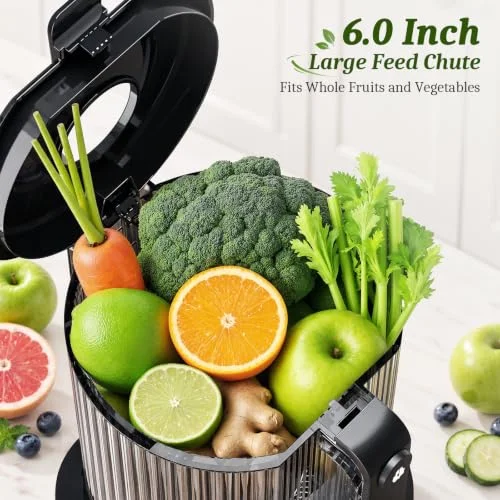
Four of the six machines here publish a feed chute between 5.4 and 6 inches. AMZCHEF’s is 5.4 inches and markets itself as whole-fruit self-feeding; Godspeeds and ECOSELF both publish 6.0-inch chutes; Canoly goes to a 6-inch “extra wide” chute paired with a self precut system that cuts produce as it feeds, rather than relying on width alone. A wider chute means fewer apples and pears halved before they go in, not zero prep: pits, large stones and thick citrus peel are still a cutting-board job on every machine here.

The hopper is a different idea entirely

Nama’s J2 skips the chute question by building a wide hopper that it says fits a whole recipe at once and feeds itself, rather than asking you to drop pieces in one at a time. That’s the real distinction: a wide chute still wants your attention while it runs; a self-feeding hopper is loaded once and left. Nama doesn’t publish a chute diameter to compare against the others — you’re buying the concept, backed by a 15-year warranty, rather than a number. Ninja publishes neither a chute width nor a hopper claim; its listing is built around the 24-ounce jug and the auger, so there’s nothing stated to compare it on.

What’s in writing

Warranty terms: 15 years, 10 years, and none stated

Juice-yield percentages and “high yield” claims show up across almost every listing in this category, and none come with a published testing method, so they can’t be compared — we treat them as marketing language, not data. A warranty term is different: it’s a number the maker is legally committing to. Nama backs the J2 with a 15-year warranty, the longest of the six, fitting its premium $479 price and self-feeding hopper. Godspeeds backs the Smoothpress with a 10-year warranty at $93.48, an unusually long term for that price tier.

AMZCHEF, Ninja and ECOSELF don’t state a warranty term, and Canoly names a motor and a precut system without naming a warranty period either. That doesn’t mean no warranty exists — sellers can carry terms that live on the product page rather than the title, and manufacturer sites sometimes publish more than the marketplace listing does. It means we have nothing to state here, and the honest move is to check the current listing before you buy rather than assume a number that isn’t written down.

Side by side

The six, compared

JuicerBest forFeed chuteListed powerWarrantyPriceGet it
Godspeeds Smoothpress Most kitchens 6 in 300 W 10 years $93.48 Get it
AMZCHEF Self-Feeding A first slow juicer 5.4 in Not listed Not listed $66.49 Get it
Ninja NeverClog JC151 Compact countertop footprint Not listed 150 W Not listed $118.79 Get it
ECOSELF 3-in-1 Juice, sorbet and nut milk on a budget 6.0 in Not listed Not listed $119.99 Get it
Canoly C16 3-in-1 Whole produce, brushless motor 6 in (extra wide) Not listed Not listed $189.93 Get it
Nama J2 Self-Feeding Hands-free daily juicing Whole-recipe hopper Not listed 15 years $479.00 Get it
The six

Our picks, and who each one is for

01Best overall

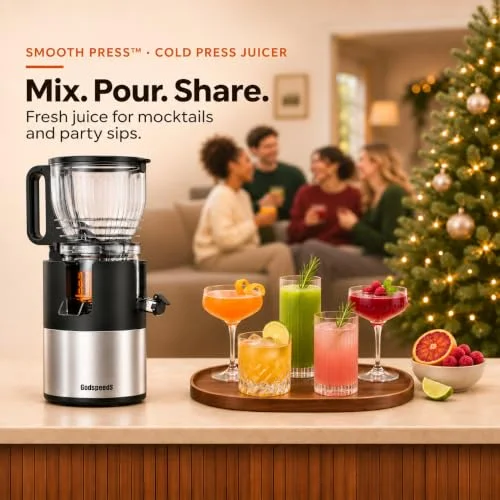
Godspeeds Smoothpress® Cold Press Juicer

Best for most kitchens: a wide chute and a long warranty at a fair price

300 W·6-inch wide chute·10-year warranty·Quick-release parts

The Smoothpress earns the top spot by publishing exactly the specs that matter and backing them with a warranty most $93 appliances don’t offer. Godspeeds builds the chute to 6 inches wide, markets the machine as whole-fruit and self-feeding, and runs the auger on a 300-watt motor — double Ninja’s wattage, though with no gear ratio published we can’t say it presses twice as hard. Cleanup is where the listing makes its second case: the parts are designed for quick-release disassembly, and a 10-year warranty is a serious commitment behind a sub-$100 juicer.

The cold press to buy if you want a wide chute and a real warranty without paying for a self-feeding hopper.

Godspeeds Smoothpress cold press juicer with wide feed chute
Price
$93.48
Check price →
02Best budget

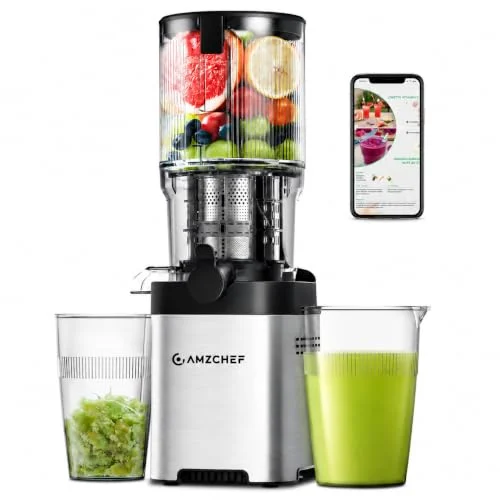
AMZCHEF Cold Press Juicer, 5.4-Inch Self-Feeding

Best for trying slow juicing without a big outlay

Masticating·5.4-inch chute·Triple strainers·Large auger

At $66.49, the AMZCHEF is the least expensive way into cold press juicing here, and it still gets the fundamentals right: a 5.4-inch self-feeding chute for whole fruit, a stainless-steel build, and a large auger paired with triple strainers — three screen stages the pulp passes through, one route to higher yield on fibrous produce without a bigger motor. The listing calls the result “high yield,” the maker’s own framing rather than a figure we can verify. The gaps: no wattage, no auger speed and no warranty term are published, and three strainers mean three parts to rinse every time.

The easiest way into slow juicing for under $70, as long as you accept the gaps in its spec sheet.

AMZCHEF self-feeding cold press juicer in stainless steel
Price
$66.49
Check price →
03Best compact

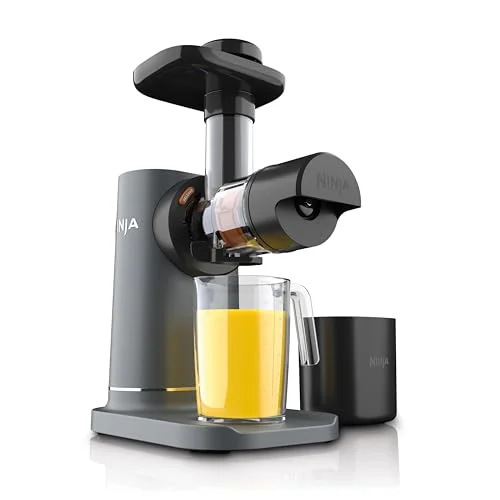
Ninja NeverClog Cold Press Juicer JC151

Best for a small counter and simple cleanup

150 W high-torque auger·24 oz jug, 36 oz pulp·2 programs·Dishwasher-safe parts

Ninja drives the auger with a 150-watt motor it describes as high-torque — the right way to read a small wattage on a slow juicer, since a masticating auger needs force applied over a long squeeze, not top-end speed. Two one-touch programs cover normal operation and Reverse, which backs the auger out when fibers bind around it, and Total Pulp Control lets you dial the texture. The listing names the parts dishwasher safe, which none of the other five machines here claims, and the 12.11 by 7.15 by 15.93-inch footprint fits most counters. Unpublished: chute width, auger RPM and warranty term; the 24-ounce jug suits one or two people.

The pick if dishwasher-safe parts and a small footprint matter more to you than a wide chute.

Ninja NeverClog JC151 cold press juicer in charcoal
Price
$118.79
Check price →
04Best 3-in-1 value

ECOSELF 3-in-1 Cold Press Juicer

Best for juice, sorbet and nut milk without paying Canoly’s price

6.0-inch chute·Large capacity·3-in-1·Recipe book + brush

ECOSELF covers the same three uses as the pricier Canoly — juice, sorbet and nut milk — through a 6.0-inch feed chute and a larger-capacity bowl, for $70 less. The listing includes a recipe book and a cleaning brush, a signal the maker expects all three functions to get used, not just juicing. Like most machines here, ECOSELF publishes no wattage, auger speed or warranty term, so weigh the lower price against those unknowns and against Canoly’s named AC brushless motor if motor longevity matters to you.

The budget route into juice-sorbet-nut milk versatility, if you’re comfortable with an unpublished motor spec.

ECOSELF 3-in-1 cold press juicer with wide feed chute
Price
$119.99
Check price →
05Best for whole produce

Canoly 3-in-1 Cold Press Juicer C16

Best for feeding in whole fruit with minimal pre-cutting

6-inch extra wide chute·AC brushless motor·Self precut system·BPA-free, Space Gray

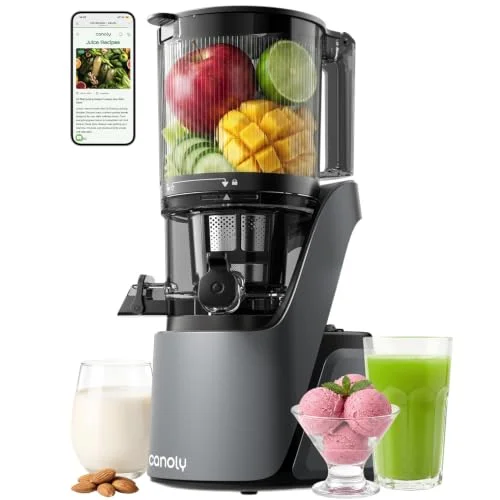
Canoly pairs its 6-inch extra-wide chute with a self precut system that cuts produce as it feeds — a different approach from relying on chute width alone, meant to accept larger pieces than a plain wide chute would. The AC brushless motor is named for its type rather than a wattage figure. Like ECOSELF, the C16 handles juice, sorbet and nut milk, with two strainers covering Juice and Sorbet modes, in a BPA-free, Space Gray body. No wattage, auger speed, capacity or warranty term is published, the trade-off for the precut system and the $189.93 price above ECOSELF’s.

If feeding in whole produce with the least pre-cutting is the point, the precut system is the reason to pick this over ECOSELF.

Canoly C16 3-in-1 cold press juicer in space gray
Price
$189.93
Check price →
06Best self-feeding

Nama J2 Self-Feeding Masticating Cold Press Juicer

Best if you juice daily and chopping is what stops you

Self-feeding hopper·Quiet 50 RPM·15-year warranty·BPA-free

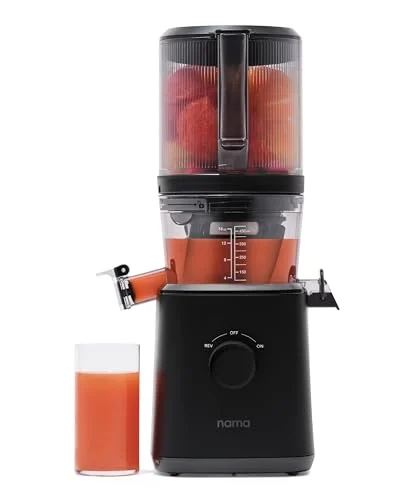
The J2 removes the chute question entirely: Nama builds a wide hopper that it says fits a whole recipe at once and feeds itself, rather than asking you to drop pieces in one at a time. The auger turns at a published 50 RPM, which Nama frames as quiet, and the maker states low pulp and zero waste as design goals. It’s the only juicer here with a stated auger speed and, at 15 years, the longest warranty — fitting for the most mechanically ambitious machine in the group. The trade-off is price: $479.00 is nearly four times the Smoothpress, and Nama publishes no wattage figure or hopper capacity to weigh against it.

If you juice every day and the chopping is what stops you, this is the machine built to take it away — at a premium price.

Nama J2 self-feeding cold press juicer in black
Price
$479.00
Check price →
The other type

Who should buy a centrifugal juicer instead

Everything on this page is a masticating, or cold press, juicer — the right choice for leafy greens, daily use, dry pulp, a quiet kitchen. It is not the right choice for everyone. If what you want is apple, carrot or beet juice made in under a minute before work, a centrifugal juicer — a fast-spinning disc and mesh basket instead of a slow auger — is the honest tool for that job: faster start-to-glass, often cheaper, fine with hard produce, at the cost of more foam, a louder motor, and weaker results with greens a spinning disc tends to fling into the pulp half-juiced.

If that trade sounds like the better fit — speed and hard produce over quiet operation and greens — a centrifugal juicer is worth comparing on its own terms. We run the full six-juicer comparison, cold press and centrifugal side by side, on the home guide.

Our method

How we picked — and what we can’t tell you

What we did

Specs, prices and manufacturer data

We compared the published specifications and current Amazon prices for six cold press juicer listings, from a $66.49 entry model to a $479.00 self-feeding flagship, and kept only the claims each maker actually states: chute width, motor wattage, auger speed, warranty term and price. We weighted chute width, self-feeding design and warranty term above marketing language, since those are concrete and comparable across listings, while yield percentages come with no published method behind them. Where a spec wasn’t stated, we said so rather than estimating it.

What we didn’t

We don’t run a testing lab

We do not physically test these juicers, we do not own them, and we publish no star ratings, review counts or paraphrased owner opinions — we have no verified review data for this set of products, and inventing sentiment would be the same offense as inventing a score. How an auger and gearbox hold up after a year of daily carrots can only be answered by years of real use in real kitchens. What we can do honestly is read every specification closely and explain the mechanics behind the numbers.

FAQ

Common questions

What does “cold press” mean on a juicer?

It means the juicer extracts juice by crushing, not shredding. A slow-turning, screw-shaped auger squeezes produce against the chamber wall and a fine mesh screen; juice passes through the screen while pulp is pressed onward and extruded as a separate, mostly dry byproduct. Nothing spins fast enough to generate heat or whip air into the juice, which is the literal basis of the “cold” in cold press — the opposite mechanism from a centrifugal juicer, which shreds on a fast-spinning disc and flings the shreds through a spinning mesh basket by centrifugal force.

Why is the wattage on a cold press juicer so much lower than a regular juicer?

Because a masticating auger needs torque — continuous squeezing force — not speed, and torque comes from gearing the motor down, not from drawing more electrical power. Ninja markets its 150-watt NeverClog auger as “high-torque” for this reason: the wattage describes electrical draw, not force at the auger shaft. A centrifugal juicer’s motor has to spin a disc at thousands of RPM, which takes considerably more raw power. Wattage tells you which mechanism you’re looking at, not which juicer works better.

What’s the real difference between a wide chute and a self-feeding hopper?

A wide chute, such as the 5.4 to 6 inches published on four of the six juicers here, lets you drop in larger pieces without pre-cutting everything to fit a narrow tube — but you’re still feeding it piece by piece as it runs. A self-feeding hopper, Nama’s approach with the J2, is built to hold an entire batch at once and feed itself, so you load it once and walk away. Both cut prep versus a narrow-chute machine; a hopper also cuts the attention the run demands.

Should I buy a cold press juicer or a centrifugal juicer?

Choose by what you’re juicing and how fast you need it. A cold press juicer is quieter, produces less foam, and handles leafy greens and celery far better, at the cost of being slower and usually pricier. A centrifugal juicer is faster start-to-glass, often cheaper, and does fine with hard produce like apples, carrots and beets, but foams more and struggles with greens. Mostly green juice, buy cold press; mostly fruit and roots made fast before work, centrifugal is the honest, cheaper choice.

Keep reading

More from Best Juicers Guide

Questions about how we research and compare juicers? Read About, or contact us directly.